

 In the fall of 2012, Israel was once again preparing for war in response to the thousands of missiles being fired indiscriminately from the Gaza strip onto the population centers of Southern Israel.
On the fourth day of Operation Pillar of Defense (Amud Anan) the Zrihen family were preparing for two very different events.
While Eva Zrihen was preparing for her wedding in Tel Aviv, her two younger brothers, Sergeant Eliahu and Captain Emmanuel, were preparing for war. Not fifty miles south of where their sister was posing for wedding photos, they were donning their flak vests and ammo pouches in the staging grounds, trying to get themselves focused for the challenge of entering Gaza in what was expected to be one of the most intensive and costly ground operations in modern warfare.
What goes through your mind on your daughter’s wedding day? I can close my eyes and see, even experience the palpable joy as we walked our daughter to her chuppah (wedding ceremony); and when I do, I can’t stop smiling even years later….
But the Zrihen family was torn between tears of joy at experiencing Eva’s wedding, and pangs of worry knowing her two brothers were about to enter combat.
Eliahu and Emmanuel were torn; how do you focus on the mission at hand, when you know you are missing your sister’s wedding? That morning they sent Eva a message telling her how sad they were to be missing her wedding, but that they expected there to be only tears of joy; they were, after all, all engaged in a mitzvah party, just celebrating two different mitzvoth ….
The hours went by but their brigade, the elite Nachal brigade, was still in the staging zone. As more rockets began falling and the sirens began to wail, the Zrihen family were headed to the wedding hall, and everyone had to take cover in the bomb shelters; it looked like the wedding celebrations were going to have to wait….
Meanwhile, just outside the Gaza strip, at approximately 9pm, for reasons still unclear, it was decided their unit would not be going in before dawn, and their base commander found Eliahu Zrihen with an important message:
“You have 15 minutes to find your brother; take my car keys and go dance at your sister’s wedding …”
Their cell phones had been taken away in preparation for entering Gaza and there was no time to find them; so no one knew they were coming. Normally, by the time they would get there the dancing would have long been over, but a few missiles from Gaza delayed everything….
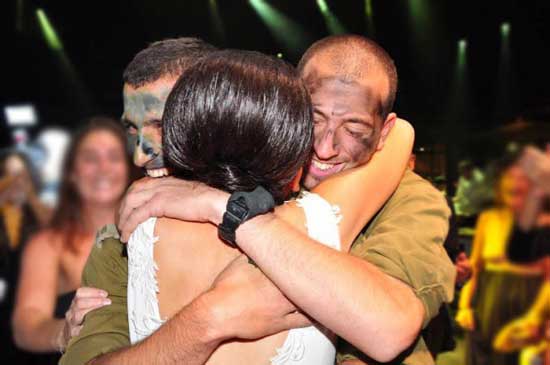
At 11pm, Eli and Emmanuel walked into the wedding hall. They had not even had time to change out of their combat gear or even take the camouflage paint off their faces. But when the two exhausted, dusty soldiers with grins as wide as the sea walked into the hall, everything just … stopped. The band stopped playing; the people stopped dancing and parted, and for a moment no one moved; until the bride turned around and let out a shout of joy, and then the entire hall erupted.
And an entire family, symbolizing an entire people; separated by 50 miles, and seemingly in two entirely different worlds that night, became one.
This week’s portion Vayakhel, begins with a rather strange moment: Moshe gathers the entire people together. In fact, it’s from this unique moment that the portion gains its name Vayakhel, which means to gather:
“And Moshe gathered together the entire Congregation of Israel…” (Shemot (Exodus) 35:1)
This is a rather unique occurrence leading all of the commentators to question why this special gathering was necessary. Why not just have Moshe tell the Jewish people what he was sharing with them as is normally the case?
Rashi points out that this actually occurred on the day following Yom Kippur, which would seem to be Rashi’s response to this question. But why does the day after Yom Kippur engender such a gathering?
In order to understand this, a little historical context is in order. The Jewish people receive the Ten Commandments at Mt Sinai on the seventh day of Sivan. Forty days later, on the 17th day of Tammuz, Moshe comes down from the mountain (in last week’s portion Ki Tissah) to find the people frolicking with the Golden Calf, at which point he hurls the Tablets of the law down the mountain. Three days later, on the twentieth day of Tammuz (usually in July), after the principal perpetrators of the Gold Calf have been dealt with, Moshe ascends the mountain a second time to gain forgiveness for the Jewish people. Forty days later he descends on the first of the month of Elul (usually in September; which today begins the period of repentance leading to the high Holy days …) to announce the people are forgiven . Then he ascends a third time for an additional forty days, to receive the second tablets (luchot) which he must hew himself.
And finally, forty days later, Moshe descends from Mount Sinai for the third and final time, on … Yom Kippur; the tenth of Tishrei. Thus, it was on Yom Kippur that the Jewish [people realized they were really forgiven and had been given a second chance, with a second set of luchot.
What Rashi was pointing out was not the connection between gathering and Yom Kippur, but rather between this gathering, the day after this particular Yom Kippur.
You see, six months after the great Exodus from Egypt, the people, like the first set of tablets were… broken. On the one hand, they had received the second tablets, but they were not nearly back where they had been when receiving the Ten Commandments.
Back on the seventh of Sivan, it was G-d Himself who was speaking to them with Moshe, from atop Mount Sinai. Now however, it was Moshe bringing the tablets to the bottom of the mountain. And more significantly, at Sinai the verse in describing the Jewish people encamping at the foot of Mount Sinai, describes:
“ … And he encamped there opposite the mountain” (Shemot 19:2),
Which Rashi describes as suggesting that the Jewish people at that moment were ‘as one, with one heart’.
And now? Now the Levites were meting out Justice to the idolaters who transgressed with the Golden calf, and the dream of Sinai seemed so far away and so… broken.
So Moshe gathers them together. And, at the behest of G-d, he gives them a special mitzvah: to build a tabernacle (Mishkan) together. Because in order for any community and any people to accomplish their dreams and goals, they have to work together; they have to become a team.
Interestingly, this word ‘Vayakhel’ to gather appears in almost exactly the same form, at the beginning of the story of the golden calf: When the people saw that Moshe was not coming:
“… Vayakhel ha’Am al Aharon”; ‘The nation ‘gathered’ around (on?) Aharon’. (32:1)
Interestingly, before the golden calf they are gathering as an Am, a nation. But here, the day after Yom Kippur they are gathered by Moshe as an Eidah, a Congregation. One might suggest that when coming to Aharon after seeing Moshe was not coming back down, the people gather for a mission; a Nation always has a purpose, a mission, which is what unites them as a Nation. Here, however, the purpose is actually to gather; How do you rebuild a broken people? Your bring them to build something together. Perhaps the Torah is alluding to the fact that they are not gathering just to build a Mishkan (a Tabernacle); they are building together in order to rediscover the beauty of being ‘gathered’.
I recently read a wonderful book on the value of team building by Patrick Lencioni, in which he describes the five dysfunctions of a team. The first dysfunction, he suggests, is trust. But not trust in the conventional sense, which is about noting the frequency of a person’s behavior resulting in assumptions with regard to future behavior. Rather, he is speaking of the confidence amongst team members that all their intentions are good, and for the good of the team or a higher purpose than themselves.
And it includes the willingness of team members to be vulnerable and share their mistakes, confident in the knowledge that they will not be judged, because all the team members simply want to help each other and become better in the interest of the team, or higher purpose.
And it also includes the ability to engage in healthy conflict and even point out other team members’ mistakes and flaws, secure in the knowledge that no-one is making it personal, but rather it’s always about the team.
As an example, if a basketball player is more concerned with his own scoring than whether the team wins, then obviously something is dysfunctional in the way that team works. On the other hand, the coach has to be able to tell a team member where he messed up without his taking it personally, because it’s not about him or her; it’s about something so much bigger.
And this is true of every team setting and every healthy relationship. Your spouse or parent has to be able to tell you where you need to improve without you taking it so personally, secure in the knowledge that they love you and have no axe to grind; they simply want to help you become even better.
And so, 3200 years ago, with the first tablets shattered at the foot of the mountain, and the dream of a better world at risk, Moshe gathers together the entire Jewish people and tells them to build a Mishkan, a special place, together.
And here is some food for thought for the Shabbat table: seventy years ago, with the Jewish people along with the Torah communities of Europe in tatters, Hashem tells us to build a State of Israel… together. And here we are, living the dream; we just have a bit of a ways to go to build it … together. Perhaps this Shabbat of Vayakhel we might all consider thinking how to get a little better at the together part ….
Shabbat Shalom from Jerusalem,
Binny Freedman